Tuesday, June 30, 2009
Today we met at CSC and discussed which direction we felt would be best for our presentation. We will be working on making outlines and deciding who should present what information in the next few days. We are thinking about having each person explain one of three key factors of a recession and one person introduce the factors and close with possible ways to get out of a recession, ways to prevent a future recession, or both. We will relay important facts to the proper person and continue with researching our countries and common factors of a recession.

Extra Information about the International Monetary Fund and G-20
While waiting at the library on Tuesday before the discussion about the presentation I found some information about the International Monetary Fund (IMF) and the G-20:
The International Monetary Fund
-The International Monetary Fund promotes international monetary cooperation and exchange rate stability, facilitates the balanced growth of international trade and provides resources to help members in balance of payment difficulties or to assist with poverty reduction. (taken from www.imf.org)
-Consists of 186 countries
-it is a special agency of the UN and has its own charter, government, and finances
-it keeps track of the economic health of its member countries and alerts them to risks on the horizon and provide policy advice
On the Agenda for the IMF:
1) Emergency lending to emerging markets
-$50 billion to 7 countries
-April 2009-$47 billion to Mexico
2) Helping low-income countries fight the crisis
3) Advocating global fiscal stimulus
-helps to address the problems and how to design effective stimulus packages
4) Reforming international financial system
Some projected statistics for the United States:
GDP-2009= $14,002.739 billion 2010=$14,050.753 billion
Inflation-2009= -0.935% change 2010= -0.084% change
Unemployment Rate-2009= 8.868% 2010= 10.109%
Gross Debt-2009= $12,180.328 billion 2010=$13,697.978 billion
Current Account Balance with IMF- 2009= -393.250 billion 2010= 396.804 billion
About the Group of 20 (G-20)
-It is a group of twenty finance ministers and central bank governors
-It was established in 1999 to bring together systemically important industrialized and developing economies to discuss key issues in the global economy (taken from www.g20.org)
-19 countries plus the European Union
-Created as a response to the financial crisis of the late 1990's
-G-20 economies comprise 85% of global gross national product
-G-20 economies account for 80% of world trade
-Also 2/3rds of the world's population
Works Cited: www.g20.org and www.imf.org
The International Monetary Fund
-The International Monetary Fund promotes international monetary cooperation and exchange rate stability, facilitates the balanced growth of international trade and provides resources to help members in balance of payment difficulties or to assist with poverty reduction. (taken from www.imf.org)
-Consists of 186 countries
-it is a special agency of the UN and has its own charter, government, and finances
-it keeps track of the economic health of its member countries and alerts them to risks on the horizon and provide policy advice
On the Agenda for the IMF:
1) Emergency lending to emerging markets
-$50 billion to 7 countries
-April 2009-$47 billion to Mexico
2) Helping low-income countries fight the crisis
3) Advocating global fiscal stimulus
-helps to address the problems and how to design effective stimulus packages
4) Reforming international financial system
Some projected statistics for the United States:
GDP-2009= $14,002.739 billion 2010=$14,050.753 billion
Inflation-2009= -0.935% change 2010= -0.084% change
Unemployment Rate-2009= 8.868% 2010= 10.109%
Gross Debt-2009= $12,180.328 billion 2010=$13,697.978 billion
Current Account Balance with IMF- 2009= -393.250 billion 2010= 396.804 billion
About the Group of 20 (G-20)
-It is a group of twenty finance ministers and central bank governors
-It was established in 1999 to bring together systemically important industrialized and developing economies to discuss key issues in the global economy (taken from www.g20.org)
-19 countries plus the European Union
-Created as a response to the financial crisis of the late 1990's
-G-20 economies comprise 85% of global gross national product
-G-20 economies account for 80% of world trade
-Also 2/3rds of the world's population
Works Cited: www.g20.org and www.imf.org
Monday, June 29, 2009
Romania: The Leu
Currency
1999
- Romania’s currency fell 6.5% towards the end of the year
-Throughout the whole year, it has lost about 1/3 of its value
-An IMF bailout was agreed to earlier this year but with the country’s careless banking reforms and slow privatization programs have delayed the bailout.
-the country owed over $2.8 billion in public and private debt
-since the beginning of the year, the leu lost 29% of its value against the dollar
2001
-Romania officially submitted to the EU council its negotiating position on Economic and Monetary Union in the beginning of November.
-They had a goal to reduce inflation to under 10% by 2004
-another goal was to make the euro the only exchange currency for the leu
2002
-at the beginning of the year, 31,600 lei equaled US$1
-In early April, 32,860 lei equaled US$1
-In late June, 33,300 lei equaled US$1
2005
- the leu plummeted in value from 21 to the dollar in 1990 to 29,890 lei to the dollar the day before the changeover
-leu means lion in Romania
-the new leu is worth about $.34 and is equal to 10,000 units of the old currency
-inflation fell to 7.5%
2007
-the leu fell 1.2% against the euro and 1.4% against the dollar
-the currency has declined since early July
2008
-the leu sharply appreciated against the euro and the dollar until early July and then steadily declined
2009
-the leu has lost more than 17.5 percent against the euro
-the country received a 20 billion-euro loan led by the IMF
-the IMF predicts that Romania’s economy will shrink by at least 4 percent this year after a growth of 7.1 percent last year
Works Cited
http://www.google.com/search?q=romania+currency+history&hl=en&tbs=tl:1&tbo=1&ei=cspISqVSlI22B_7_2ZAG&sa=X&oi=timeline_result&ct=title&resnum=11
1999
- Romania’s currency fell 6.5% towards the end of the year
-Throughout the whole year, it has lost about 1/3 of its value
-An IMF bailout was agreed to earlier this year but with the country’s careless banking reforms and slow privatization programs have delayed the bailout.
-the country owed over $2.8 billion in public and private debt
-since the beginning of the year, the leu lost 29% of its value against the dollar
2001
-Romania officially submitted to the EU council its negotiating position on Economic and Monetary Union in the beginning of November.
-They had a goal to reduce inflation to under 10% by 2004
-another goal was to make the euro the only exchange currency for the leu
2002
-at the beginning of the year, 31,600 lei equaled US$1
-In early April, 32,860 lei equaled US$1
-In late June, 33,300 lei equaled US$1
2005
- the leu plummeted in value from 21 to the dollar in 1990 to 29,890 lei to the dollar the day before the changeover
-leu means lion in Romania
-the new leu is worth about $.34 and is equal to 10,000 units of the old currency
-inflation fell to 7.5%
2007
-the leu fell 1.2% against the euro and 1.4% against the dollar
-the currency has declined since early July
2008
-the leu sharply appreciated against the euro and the dollar until early July and then steadily declined
2009
-the leu has lost more than 17.5 percent against the euro
-the country received a 20 billion-euro loan led by the IMF
-the IMF predicts that Romania’s economy will shrink by at least 4 percent this year after a growth of 7.1 percent last year
Works Cited
http://www.google.com/search?q=romania+currency+history&hl=en&tbs=tl:1&tbo=1&ei=cspISqVSlI22B_7_2ZAG&sa=X&oi=timeline_result&ct=title&resnum=11
Zimbabwe
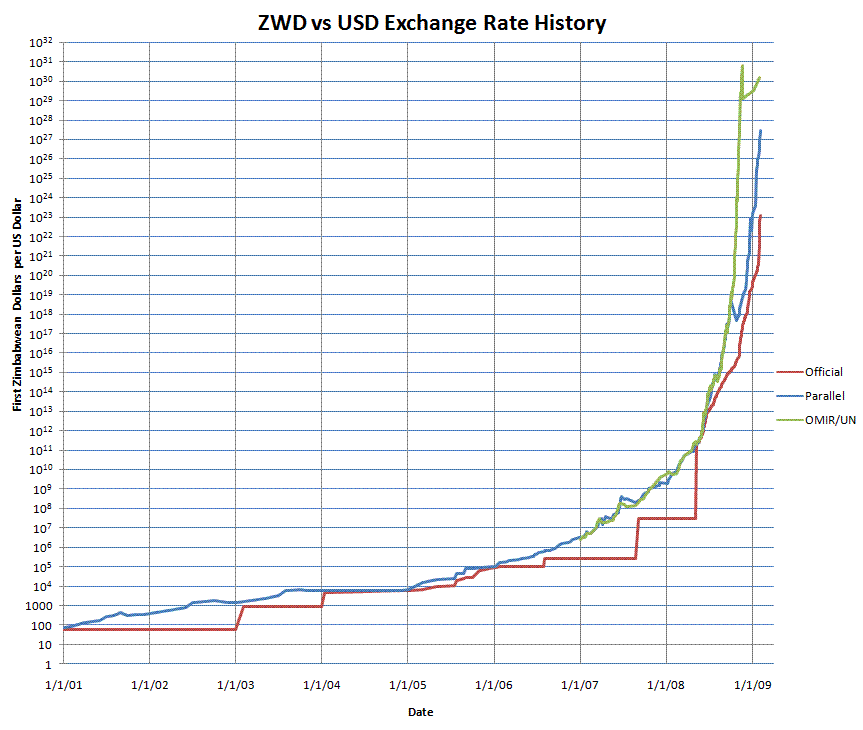
This graph shows the exchange rate between a Zimbabwe dollar (ZWD) and a U.S. dollar (USD).
This graph shows the exchange rate between a Zimbabwe dollar (ZWD) and a U.S. dollar (USD).
Most of this information came from a article that is from around 2007, therefore some of the information here may be incorrect now.
Zimbabwe has suffered from hyperinflation for about five years. In 2006, Zimbabwe had the greatest inflation level in all of Africa. In December 1997, Zimbabwe had an annual inflation rate of twenty percent. In February 2007, Zimbabwe's inflation rate hit 1,594 percent.
Zimbabwe's banking sector is made up of seventeen commercial banks. Three commercial banks, including the largest one, have some degree of state ownership; however the other fourteen are privately owned. Four of the privately owned banks are foreign-owned. A number of the banks have been faced with liquidity crises due to the worsening economy in Zimbabwe. The insurance sector consists of nine life insurance firms, 26 general insurance firms and six re-insurers. All are under the supervision of the Zimbabwe Ministry of Finance, Economic Planning and Development.
Zimbabwe's stock exchange had a market capitalisation of about twenty billion USD at the end of 2006. The stock market offered its highest returns in Africa in 2005 and for most of 2006 despite the deep recession in Zimbabwe. This was driven by local investors hoping to make significant returns on their investments in the midst of hyperinflation.
United States Currency
The United States Currency as everyone knows is the dollar. Here are some things and facts I have found about our currency:
*The US currency is the most used currency in international transactions
*It is a fiat currency (money declared by a government to be the official currency)
-even though it is fiat currency other countries use it as their official currency or their “de facto currency” (not legal tender but used by most of the population)
examples: Lebanon, Zimbabwe, Iraq, Panama, Somalia
*Denominations equal or greater than a dollar are emitted as Federal Reserve Notes
*Denominations less than a dollar are emitted as US Coins
*Made from 75% cotton fiber paper and 25% linen
* Inflation = .74%
*Nicknames:
-buck
-paper
-scrillas
-bones
-dough
-greens
-greenbacks
- (name of person on it)
* $ = two vertical bars with a cloth band in the shape of an “S”
*The US Dollar was created and defined by the Coinage Act of 1792
* Backed by gold
*The dollar is less than a euro
Exchange rate as of 15 min ago: US $1 = € 0.7115
€1 = US $ 1.4055
http://www.dollars2euro.com/ updates it every 15 minutes
* The Bureau of Engraving and Printing is the printer of the money
*The Central Bank is the Federal Reserve Bank-Ben S. Bernanke
* The Mint is the United State Mint (where the money is made)
*During fiscal year 2007, the Bureau of Engraving and Printing (BEP) produced approximately 38 million notes a day with a face value of approximately $750 million.
*95% of the notes printed each year are used to replace notes already in, or taken out of circulation.
*The first paper currency issued by the U.S. Department of the Treasury were Demand Notes Series 1861.
*You could get a $5,000 fine or 15 years in prison if you are found counterfeiting currency.
*The U.S. technically makes money when it prints more because of seigniorage. This means that it takes a few cents to make a quarter but in circulation it is 25 cents. This puts extra funds in the Treasury and goes towards education, health care, and defense.
*The life expectancy of a circulating coin is 30 years, while paper money usually only lasts for 18 months.
Works Cited: www.federalreserve.gov and www.moneyfactory.gov and www.usmint.gov
*The US currency is the most used currency in international transactions
*It is a fiat currency (money declared by a government to be the official currency)
-even though it is fiat currency other countries use it as their official currency or their “de facto currency” (not legal tender but used by most of the population)
examples: Lebanon, Zimbabwe, Iraq, Panama, Somalia
*Denominations equal or greater than a dollar are emitted as Federal Reserve Notes
*Denominations less than a dollar are emitted as US Coins
*Made from 75% cotton fiber paper and 25% linen
* Inflation = .74%
*Nicknames:
-buck
-paper
-scrillas
-bones
-dough
-greens
-greenbacks
- (name of person on it)
* $ = two vertical bars with a cloth band in the shape of an “S”
*The US Dollar was created and defined by the Coinage Act of 1792
* Backed by gold
*The dollar is less than a euro
Exchange rate as of 15 min ago: US $1 = € 0.7115
€1 = US $ 1.4055
http://www.dollars2euro.com/ updates it every 15 minutes
* The Bureau of Engraving and Printing is the printer of the money
*The Central Bank is the Federal Reserve Bank-Ben S. Bernanke
* The Mint is the United State Mint (where the money is made)
*During fiscal year 2007, the Bureau of Engraving and Printing (BEP) produced approximately 38 million notes a day with a face value of approximately $750 million.
*95% of the notes printed each year are used to replace notes already in, or taken out of circulation.
*The first paper currency issued by the U.S. Department of the Treasury were Demand Notes Series 1861.
*You could get a $5,000 fine or 15 years in prison if you are found counterfeiting currency.
*The U.S. technically makes money when it prints more because of seigniorage. This means that it takes a few cents to make a quarter but in circulation it is 25 cents. This puts extra funds in the Treasury and goes towards education, health care, and defense.
*The life expectancy of a circulating coin is 30 years, while paper money usually only lasts for 18 months.
Works Cited: www.federalreserve.gov and www.moneyfactory.gov and www.usmint.gov
argentina currency

since the "dirty war" in the 1970's, the economy and currency value in argentina have fluctuated greatly. the goal for the argentine government was to keep the argentine peso at 1 to 1 with the us dollar to promote economic stability.
in 1999, due to the recession, the IMF gave argentina a $40 billion aid package. even with this, the economy continued to fail. and in 2002, the governments goal of keeping the peso at a 1 to 1 with the us dollar was abandoned. after this in 2002, the argentine peso became a free floating currency and lost 60% of its value.
but do to major reforms in the argentine economy, the peso has seen a steady recovery. as an additional effort to increase the strength of the peso, the government has been buying on average $20 million usd per day.
on the graph, it measures the CPI, which shows the inflation at the current time.
http://en.wikipedia.org/wiki/Argentine_economic_crisis_(1999%E2%80%932002)
Friday, June 26, 2009
Romania Industry and Working
Industry
Romania has rich and fertile land which has abundant mineral deposits. However, since the 1960's industry has gradually passed agriculture as the country's main source of income as well as its primary employer. Romania does not specialize in just one or two products. Romania makes a variety of different things. Their main industries are iron, steel, nonferrous metals, chemicals, food processing, machinery and transportation equipment, textiles and clothing, electronics, construction, furniture and other wood products, shipbuilding and refurbishment, windmills, pharmaceuticals, medical equipment, textiles and footwear, light machinery and auto assembly, mining, timber, construction materials, metallurgy, petroleum refining, and computers.


Working
The unemployment rate is about 6% and 25% of the population live below the poverty line.
-a person can legally work at the age of 16
-may work at 15 with parents permission
-cannot work if under 15
-full time consists of 8 hours a day and 4o hours a week
-full time employees cannot go over 48 hours in one week, including overtime
-for every 5 days of 8 hour work, there must be two days off
-people under 8 can only work up to 6 hours a day and 3o hours a week
-if shifts are 12 hours, it must be followed by 24 hours of rest
-minimum wage is 600 new lei which is $198.89 US per month
Romania has rich and fertile land which has abundant mineral deposits. However, since the 1960's industry has gradually passed agriculture as the country's main source of income as well as its primary employer. Romania does not specialize in just one or two products. Romania makes a variety of different things. Their main industries are iron, steel, nonferrous metals, chemicals, food processing, machinery and transportation equipment, textiles and clothing, electronics, construction, furniture and other wood products, shipbuilding and refurbishment, windmills, pharmaceuticals, medical equipment, textiles and footwear, light machinery and auto assembly, mining, timber, construction materials, metallurgy, petroleum refining, and computers.


Working
The unemployment rate is about 6% and 25% of the population live below the poverty line.
-a person can legally work at the age of 16
-may work at 15 with parents permission
-cannot work if under 15
-full time consists of 8 hours a day and 4o hours a week
-full time employees cannot go over 48 hours in one week, including overtime
-for every 5 days of 8 hour work, there must be two days off
-people under 8 can only work up to 6 hours a day and 3o hours a week
-if shifts are 12 hours, it must be followed by 24 hours of rest
-minimum wage is 600 new lei which is $198.89 US per month
Works Cited
Zimbabwe
Zimbabwe's inflation rate reach 230 million percent in July 2008. Shortly after, Zimbabwe quit issuing the inflation rate. A Z100 billion note was issued. It could barely buy a loaf of bread. A Z100 trillion note followed. Zimbabwe abandoned its currency in January 2009 and is allowing currencies from other countries to be used.
Zimbabwe's service sector accounts for 59 percent of Zimbabwe's GDP. The most important parts of the service sector are tourism, education, and public services.
Zimbabwe's inflation rate reach 230 million percent in July 2008. Shortly after, Zimbabwe quit issuing the inflation rate. A Z100 billion note was issued. It could barely buy a loaf of bread. A Z100 trillion note followed. Zimbabwe abandoned its currency in January 2009 and is allowing currencies from other countries to be used.
Zimbabwe's service sector accounts for 59 percent of Zimbabwe's GDP. The most important parts of the service sector are tourism, education, and public services.
United States Industry
The topic for today is the industry of our country. Therefore here are some facts I have found from random sources but mostly the CIA Fact Book.
1. According to the International Monetary Fund, the U.S. GDP of $14.3 trillion constitutes 23% of the gross world power at market exchange rates and almost 21% of the gross world product at purchasing power parity.
2. The United States is the largest importer of goods.
3. It is also the third largest exporter.
4. The United States is the 3rd largest producer of oil in the world.
5. On the other hand, it is the largest importer of oil.
6. It is the world’s number one producer of electrical and nuclear energy in the world, as well as the number one producer of liquid natural gas, sulfur, phosphate, and salt.
7. The U.S.’s leading export commodity is electrical machinery.
8. Its leading importing good is vehicles.
9. In 2008, the trade deficit was $810 billion.
Here are some statistics about the industry:
-labor force= 155.2 million
by occupation:
- .6% forestry and fishing
- 22.6% manufacturing, extraction, transportation, and crafts
- 35.5% professional and technical
- 24.8% sales and office
- 16.5% other
- Export Commodities=agricultural products (soybeans, fruit, corn) 9.2%, industrial supplies (organic chemicals) 26.8%, capital goods (transistors, aircraft, motor vehicle parts, computers, telecommunications equipment) 49.0%, consumer goods (automobiles, medicines) 15.0%
-Import Commodities= agricultural products 4.9%, industrial supplies 32.9% (crude oil 8.2%), capital goods 30.4% (computers, telecommunications equipment, motor vehicle parts, office machines, electric power machinery), consumer goods 31.8% (automobiles, clothing, medicines, furniture, toys)
-Importing Partners= China 16.9%, Canada 15.7%, Mexico 10.6%, Japan 7.4%, Germany 4.8% (2007)
-Export Partners= Canada 21.4%, Mexico 11.7%, China 5.6%, Japan 5.4%, UK 4.3%, Germany 4.3%
-Exports= $1.377 trillion
-Imports=$2.19 trillion
List of Industries:
leading industrial power in the world, highly diversified and technologically advanced; petroleum, steel, motor vehicles, aerospace, telecommunications, chemicals, electronics, food processing, consumer goods, lumber, mining
List of Agriculture Products:
wheat, corn, other grains, fruits, vegetables, cotton; beef, pork, poultry, dairy products; fish; forest products
Works Cited: http://www.theodora.com/wfbcurrent/united_states/united_states_economy.html
1. According to the International Monetary Fund, the U.S. GDP of $14.3 trillion constitutes 23% of the gross world power at market exchange rates and almost 21% of the gross world product at purchasing power parity.
2. The United States is the largest importer of goods.
3. It is also the third largest exporter.
4. The United States is the 3rd largest producer of oil in the world.
5. On the other hand, it is the largest importer of oil.
6. It is the world’s number one producer of electrical and nuclear energy in the world, as well as the number one producer of liquid natural gas, sulfur, phosphate, and salt.
7. The U.S.’s leading export commodity is electrical machinery.
8. Its leading importing good is vehicles.
9. In 2008, the trade deficit was $810 billion.
Here are some statistics about the industry:
-labor force= 155.2 million
by occupation:
- .6% forestry and fishing
- 22.6% manufacturing, extraction, transportation, and crafts
- 35.5% professional and technical
- 24.8% sales and office
- 16.5% other
- Export Commodities=agricultural products (soybeans, fruit, corn) 9.2%, industrial supplies (organic chemicals) 26.8%, capital goods (transistors, aircraft, motor vehicle parts, computers, telecommunications equipment) 49.0%, consumer goods (automobiles, medicines) 15.0%
-Import Commodities= agricultural products 4.9%, industrial supplies 32.9% (crude oil 8.2%), capital goods 30.4% (computers, telecommunications equipment, motor vehicle parts, office machines, electric power machinery), consumer goods 31.8% (automobiles, clothing, medicines, furniture, toys)
-Importing Partners= China 16.9%, Canada 15.7%, Mexico 10.6%, Japan 7.4%, Germany 4.8% (2007)
-Export Partners= Canada 21.4%, Mexico 11.7%, China 5.6%, Japan 5.4%, UK 4.3%, Germany 4.3%
-Exports= $1.377 trillion
-Imports=$2.19 trillion
List of Industries:
leading industrial power in the world, highly diversified and technologically advanced; petroleum, steel, motor vehicles, aerospace, telecommunications, chemicals, electronics, food processing, consumer goods, lumber, mining
List of Agriculture Products:
wheat, corn, other grains, fruits, vegetables, cotton; beef, pork, poultry, dairy products; fish; forest products
Works Cited: http://www.theodora.com/wfbcurrent/united_states/united_states_economy.html
Thursday, June 25, 2009
Romania Banking
Banking
I’m not finding much on how the banking in Romania works. They keep refers to themselves as they are like Americans. I found some tasks also of the National Bank of Romania.
These tasks include:
-to name and apply the monetary policy and the exchange rate policy
-to conduct the authorization, regulation and supervision of credit institutions and to support and manage the smooth process of the payment systems with a view to ensuring financial stability
-to issue banknotes and coins as legal tender on the land of Romania
-to set the exchange rate administration and to supervise its observance
-to manage the official reserves of Romania
Works Cited
http://en.wikipedia.org/wiki/National_Bank_of_Romania
I’m not finding much on how the banking in Romania works. They keep refers to themselves as they are like Americans. I found some tasks also of the National Bank of Romania.
These tasks include:
-to name and apply the monetary policy and the exchange rate policy
-to conduct the authorization, regulation and supervision of credit institutions and to support and manage the smooth process of the payment systems with a view to ensuring financial stability
-to issue banknotes and coins as legal tender on the land of Romania
-to set the exchange rate administration and to supervise its observance
-to manage the official reserves of Romania
Works Cited
http://en.wikipedia.org/wiki/National_Bank_of_Romania
United States Banking Sysetm
To start off with the United States has a dual banking system. This refers to the parallel state and federal banking systems. The federal system is based on a federal bank charter, powers are defined under federal law, is operated under federal standards and is overseen by a federal supervisor. The state system is they same yet different. It is based on a state bank charter, its powers are defined by state law, it operated under state standards, and is overseen by a state supervisor.
The Office of the Comptroller of Currency, also known as the OCC charters the national banks. It also makes sure that the national banks are safe and sound. They also conduct risk assessments and ranks the national banks.
This dual system also relies on the checks and balances system.
There is also the Federal Reserve. I believe I have talked about it in an earlier blog but it applies here too:
-it is independent from the Treasury Department
-its role is to foster a sound banking system and healthy economy
-it regulates and supervises the economy
-it has provided an enormous amount of liquidity to private institutions to restore the normal functioning of credit
-it also was the agency that gave $85 billion to AIG in loans
Works Cited: http://www.occ.treas.gov/ and "This Is Not Your Father's Recession...Or Is It" By Charles S. Gascon
The Office of the Comptroller of Currency, also known as the OCC charters the national banks. It also makes sure that the national banks are safe and sound. They also conduct risk assessments and ranks the national banks.
This dual system also relies on the checks and balances system.
There is also the Federal Reserve. I believe I have talked about it in an earlier blog but it applies here too:
-it is independent from the Treasury Department
-its role is to foster a sound banking system and healthy economy
-it regulates and supervises the economy
-it has provided an enormous amount of liquidity to private institutions to restore the normal functioning of credit
-it also was the agency that gave $85 billion to AIG in loans
Works Cited: http://www.occ.treas.gov/ and "This Is Not Your Father's Recession...Or Is It" By Charles S. Gascon
Zimbabwe
Zimbabwe had been using a fiat system. Zimbabwe's fiat system collapsed. More money was printed as the money was losing its value. The money lost even more of its value. The inflation is so bad that a newspaper cost Z25 billion in July 2008. A few weeks before it cost Z200,000. Computers in banks and ATMs could not keep up with the hyperinflation in 2008. Before the inflation began, the US dollar and the Zimbabwe dollar were about equal in exchange. In July 2008, one US dollar equalled 50 billion Zimbabwe dollars. The inflation is so out of control that people's wages cannot keep up. People in Zimbabwe are aware that printing more and more money causes, or at least attributes to, inflation.
Zimbabwe had been using a fiat system. Zimbabwe's fiat system collapsed. More money was printed as the money was losing its value. The money lost even more of its value. The inflation is so bad that a newspaper cost Z25 billion in July 2008. A few weeks before it cost Z200,000. Computers in banks and ATMs could not keep up with the hyperinflation in 2008. Before the inflation began, the US dollar and the Zimbabwe dollar were about equal in exchange. In July 2008, one US dollar equalled 50 billion Zimbabwe dollars. The inflation is so out of control that people's wages cannot keep up. People in Zimbabwe are aware that printing more and more money causes, or at least attributes to, inflation.
Business Culture
-Romania is a bureaucracy
-Personal relationships are a good idea to get what you want
Establishing Relationships
-they like to do business with down-to-earth people that do not brag about their achievements
-as long as you are considered an outsider you will be treated formally
-once considered an insider, you will be treated informally
Business Meetings
-Appointments should be made in advanced by 2-3 weeks and they like them to be made by letters
-it is difficult to schedule a meeting during July and August due to vacations
-the best time to plan appointments are between 9a.m. and 5 p.m.
-businesspeople are unavailable two weeks before and after Christmas and a week before and after Easter
-arrive on time and be ready to wait
-meetings are formal and follow “old-world” rules of courtesy
-wait to be told where to sit
-do not remove your suit jacket until told to or the most senior ranking Romanian removes his
-expect to get to know each other before diving into business
-presentation should be straight forward and simple
-include facts and figures to back up your conclusions
-avoid exaggerations
-office and washroom normally remain closed to ensure that you knock. When done using, close the door behind you
-the relationship between family, friends, and neighbors are extremely important
-welcome topics to talk about are Romanian history, Romanian arts, sports especially soccer, Food and wine, Romanian landscape, famous opera singers, and current events.
-avoid talking about religion, politics, taxes, corruption in the Romanian government, criticizing Romanian culture, stereotypes, questions about private family concerns, negative comments about the local softball team, making off-color jokes
Negotiating
-most decisions require many approvals
-it takes several meetings to accomplish a simple task
-can be tough negotiators
-they do not want to be taking advantage of from foreigners
-hire a negotiator to go with you
-they have a habit to tell others what they want to hear
-avoid confrontational behavior
-decisions are easily reversed
-use an indirect negotiating style. Direct can be viewed as poor manners
-do not change your team of negotiators before a decision is decided or the relationship-building process will have to be restarted
-final decisions are really slow and can take anywhere from 3 months to a year
-complimenting and rewarding is not done
Business Cards
- they are exchanged without formal ritual
-if your business has survived 50 years, include the founding date on your cards. Romanians are impressed by stability.
-include any university degrees on the card.
-have one side of the card in English and on the back side have it translated into Romanian
Gifts
- recommended gifts are chocolate, flowers or crafts and liquor from your own country
-give an odd number of flowers because even numbers are used for funerals
-roses are for romance and carnations are for funerals
- gifts are opened when received
-secretaries like gifts too
-gifts for children are a good idea too
-gifts to avoid are towels and handkerchiefs because they are associated with funerals, gifts wrapped in black paper because black signifies mourning, and gifts wrapped in purple because purple is a symbolic baby color for little girls
Works Cited
http://www.kwintessential.co.uk/resources/global-etiquette/romania.html
http://www.2cbc.net/2002/introductions/dos/dos_and_don'ts.pdf
-Romania is a bureaucracy
-Personal relationships are a good idea to get what you want
Establishing Relationships
-they like to do business with down-to-earth people that do not brag about their achievements
-as long as you are considered an outsider you will be treated formally
-once considered an insider, you will be treated informally
Business Meetings
-Appointments should be made in advanced by 2-3 weeks and they like them to be made by letters
-it is difficult to schedule a meeting during July and August due to vacations
-the best time to plan appointments are between 9a.m. and 5 p.m.
-businesspeople are unavailable two weeks before and after Christmas and a week before and after Easter
-arrive on time and be ready to wait
-meetings are formal and follow “old-world” rules of courtesy
-wait to be told where to sit
-do not remove your suit jacket until told to or the most senior ranking Romanian removes his
-expect to get to know each other before diving into business
-presentation should be straight forward and simple
-include facts and figures to back up your conclusions
-avoid exaggerations
-office and washroom normally remain closed to ensure that you knock. When done using, close the door behind you
-the relationship between family, friends, and neighbors are extremely important
-welcome topics to talk about are Romanian history, Romanian arts, sports especially soccer, Food and wine, Romanian landscape, famous opera singers, and current events.
-avoid talking about religion, politics, taxes, corruption in the Romanian government, criticizing Romanian culture, stereotypes, questions about private family concerns, negative comments about the local softball team, making off-color jokes
Negotiating
-most decisions require many approvals
-it takes several meetings to accomplish a simple task
-can be tough negotiators
-they do not want to be taking advantage of from foreigners
-hire a negotiator to go with you
-they have a habit to tell others what they want to hear
-avoid confrontational behavior
-decisions are easily reversed
-use an indirect negotiating style. Direct can be viewed as poor manners
-do not change your team of negotiators before a decision is decided or the relationship-building process will have to be restarted
-final decisions are really slow and can take anywhere from 3 months to a year
-complimenting and rewarding is not done
Business Cards
- they are exchanged without formal ritual
-if your business has survived 50 years, include the founding date on your cards. Romanians are impressed by stability.
-include any university degrees on the card.
-have one side of the card in English and on the back side have it translated into Romanian
Gifts
- recommended gifts are chocolate, flowers or crafts and liquor from your own country
-give an odd number of flowers because even numbers are used for funerals
-roses are for romance and carnations are for funerals
- gifts are opened when received
-secretaries like gifts too
-gifts for children are a good idea too
-gifts to avoid are towels and handkerchiefs because they are associated with funerals, gifts wrapped in black paper because black signifies mourning, and gifts wrapped in purple because purple is a symbolic baby color for little girls
Works Cited
http://www.kwintessential.co.uk/resources/global-etiquette/romania.html
http://www.2cbc.net/2002/introductions/dos/dos_and_don'ts.pdf
Wednesday, June 24, 2009
Basic Culture and Background of Romania
Basic Culture and Background

- Romania is a hierarchy. Age and position are respected.
-The father of a family runs the house. It’s a patriarch.
-They are formal and have a strong need of privacy.
-most do not trust strangers.
-they are generally shy and quiet when you first meet them and never are called by their first name, always their title and surname.
Meeting
-First greeting are formal. A handshake, direct eye contact, and the appropriate greeting for that time in the day.
-The older Romanians will kiss a woman’s hand.
-close friends may kiss and hug each other when they meet. The will kiss both cheeks, starting with the left first.
Titles
-People are dressed by their titles. "Domnul" for Mr. and "Doamna" for Mrs. and their surname.
-only close friends call them by their first name.
Gifts
- recommended gifts are chocolate, flowers or imported liquor
-give an odd number of flowers because even numbers are used for funerals
-they like roses and carnations
- gifts are opened when received
-gifts for children are a good idea too
Dining Rules
-arrive on time if invited to dinner but you can be late for a party by 15 minutes
-dress in office clothes
-if shoes are at the front door, take yours off as well
-use table manners
-wait to sit. There is usually a seating chart
-leave napkin on table. Do not put it on your lap.
-wait for host to say “pofta buna” (good appetite) before eating
-keeps hand visible on table with wrists on table edge
-if you are not done eating, cross your knife and fork on your plate
-when done eating, place your knife and fork across your plate with prongs facing down and the handles to the right

- Romania is a hierarchy. Age and position are respected.
-The father of a family runs the house. It’s a patriarch.
-They are formal and have a strong need of privacy.
-most do not trust strangers.
-they are generally shy and quiet when you first meet them and never are called by their first name, always their title and surname.
Meeting
-First greeting are formal. A handshake, direct eye contact, and the appropriate greeting for that time in the day.
-The older Romanians will kiss a woman’s hand.
-close friends may kiss and hug each other when they meet. The will kiss both cheeks, starting with the left first.
Titles
-People are dressed by their titles. "Domnul" for Mr. and "Doamna" for Mrs. and their surname.
-only close friends call them by their first name.
Gifts
- recommended gifts are chocolate, flowers or imported liquor
-give an odd number of flowers because even numbers are used for funerals
-they like roses and carnations
- gifts are opened when received
-gifts for children are a good idea too
Dining Rules
-arrive on time if invited to dinner but you can be late for a party by 15 minutes
-dress in office clothes
-if shoes are at the front door, take yours off as well
-use table manners
-wait to sit. There is usually a seating chart
-leave napkin on table. Do not put it on your lap.
-wait for host to say “pofta buna” (good appetite) before eating
-keeps hand visible on table with wrists on table edge
-if you are not done eating, cross your knife and fork on your plate
-when done eating, place your knife and fork across your plate with prongs facing down and the handles to the right
Works Cited
Zimbabwe Business Etiquette
Greeting-
Between men:
Greeting-
Between men:
- Firm handshake with right hand
- Hugs and pats on the back are common among close friends and family
- Firm handshake with right hand
- Hugs and pats on the back are common among close friends and family
- In rural areas a handshake with the right hand and a simultaneous slight genuflection is normal
- Handshake with the right hand is common
- In rural areas a handshake with the right hand followed by a small step backwards with a simultaneous slight genuflection when each person claps softly with cupped hands - some variations are used depending on the area
Communicating:
- Direct communication is preferred in urban areas
- Never use first names unless invited to do so
- Use Mr., Mrs., Dr., etc
- Indirect speaking is used in rural areas
- A woman who has become a mother for the first time is referred to as "the mother of ______" the father is "the father of _______"
- If a woman is married but does not have children she is Amai followed by her husband's surname
- Personal questions such as age and income are common
Personal Space and Touching:
- In cities arm length space is very important during conversations
- If you are male, it is best never to touch or put your arm on a married woman (this is disrespectful)
- In rural areas personal space between men and men can be very close and same for women and women but more than arm's length is common between men and women
- When feeling excited or happy during a conversation shaking hands, holding hands, and light pats on the back are common (more often very close friends of the same sex)
- There is little to no touching during initial and business meetings
Eye Contact:
- In cities and towns direct eye contact is normal and seen as an indication of honesty while indirect eye contact is seen as rude
- In rural areas if a man is speaking to a woman the woman usually looks off in the distance or at the ground (this is a sign of respect)
- If a father is speaking to a daughter, she would kneel and avoid eye contact to show respect
Views of time:
- Many people are laid back and do not care if a person is late to an event such as a party
- Arriving on time is valued but it is not a big deal if you are late
- Transportation services rarely run on time
- Time is very important for business
- People often give their time freely (especially for social events)
Gestures:
- The thumbs up is a sign that everything is okay
- Pointing is done with the index finger
- Whistling is used to call someone, get their attention, and to stop a bus or other moving vehicle
- Sticking your tongue out at anyone, especially an elderly person, is considered very rude
- Making a hissing sound or any other sound with the mouth is considered impolite
- Licking your lips while staing at someome of the opposite sex is considered obscene
- Speaking to someone with your hands in your pockets is considered rude
Business Dress:
- Business people dress well
- Men wear formal suits with ties and dark colors are preferred
- Women dress conservative yet stylishly and avoid expensive accesories and skirts or dresses above the knee and sleeveless attire
Business Cards:
- Exchange with right hand
- Sometimes both hands are used
Meetings:
- Showing up on time gives a good impression
- It is customary to greet whoever is closest to you or whoever you meet first
- Allow the host to begin and end the meeting
Negotiations:
- It is best to be honest about prices
- Emotions may be necessary in some instances (not always)
- Be calm
- Expect people to need time to think things through before making a decision
Gifts:
- Gifts are not expected but appreciated
- Gifts can be a positive gesture
- People would not be offended if a gift was offered
- Appropiate gifts include items found in one's country but not in Zimbabwe
- Gifts should be wrapped and are usually opened in private
If you can larn some basic phrases such as "how are you?," "good morning," and "good evening" you could be viewed as having an interest in Zimbabwe and its people rather than just the business side of the country.
Romania Housing
Housing Crisis
-population = 21.6 million people
- 15% live under the poverty line. 2.4 million live in extreme poverty and 1.2 million can’t obtain their everyday needs
-the unemployed, farmers, and housewives are most affected by severe poverty
-2/3 of Romania’s population is into agriculture, forestry, and fisheries
- 2005 and 06, they faced the worst floods in 100 years and in July of 2008, they had new floods in the northern countries and it left thousands of people without homes
-Many Romanians live in crowed houses and only half have access to piped water
-house quality is poor. Many houses are deteriorating because of lack of maintenance
-EX- a family of 8 would live in a 2 bedroom flat rather than a 4 or bedroom house
-many families live together
-it’s common for children to live with parents through their 20’s or 30’s because finding a house that is affordable is hard
-What’s being done?
- Habitat for Humanity has begun to help Romania. They have helped 1,185 families by building houses, rehabilitations, repairs, technical, financial and other services as well.
- Other groups that have helped out are USAID, CHF, UNICEF, Soros Foundation, andASCO Oradea
-Companies such as Petrom, Vodafone, Isover, Consolis, Pfizer, Arcelor Mittal, Lafarge, BRD Societe Generale, Timken, Whirlpool, MoneyGram, ABN AMRO, CitiBank, AVIVA, and European Western Union are bringing their support to remove poverty houses in Romania.
-population = 21.6 million people
- 15% live under the poverty line. 2.4 million live in extreme poverty and 1.2 million can’t obtain their everyday needs
-the unemployed, farmers, and housewives are most affected by severe poverty
-2/3 of Romania’s population is into agriculture, forestry, and fisheries
- 2005 and 06, they faced the worst floods in 100 years and in July of 2008, they had new floods in the northern countries and it left thousands of people without homes
-Many Romanians live in crowed houses and only half have access to piped water
-house quality is poor. Many houses are deteriorating because of lack of maintenance
-EX- a family of 8 would live in a 2 bedroom flat rather than a 4 or bedroom house
-many families live together
-it’s common for children to live with parents through their 20’s or 30’s because finding a house that is affordable is hard
-What’s being done?
- Habitat for Humanity has begun to help Romania. They have helped 1,185 families by building houses, rehabilitations, repairs, technical, financial and other services as well.
- Other groups that have helped out are USAID, CHF, UNICEF, Soros Foundation, andASCO Oradea
-Companies such as Petrom, Vodafone, Isover, Consolis, Pfizer, Arcelor Mittal, Lafarge, BRD Societe Generale, Timken, Whirlpool, MoneyGram, ABN AMRO, CitiBank, AVIVA, and European Western Union are bringing their support to remove poverty houses in Romania.
Works Cited
United States Business Culture
Here are some "norms" of American business culture:
1. Work comes first
- very task oriented and have a goal in mind and will work until we achieve it
2. Be very clear on what you say
-if you aren't then it can be seem as dishonest because you will be "beating around the bush"
3. Honesty is the best policy
-no bribes, kickbacks, or unlawful payoffs
4. Logic Rules over emotion
-do not appear emotional or unable to make a cold hard decision
5. Respect the elders
-they should be respected as the wisest and most seasoned individuals on the team
6. Women are equal players
-do not belittle them, ask them out, or treat them like secretaries (unless they really are)
7. Do not discuss politics or religion
-they have deep rooted beliefs and should not be talked about in a business setting
-Instead talk about: sports, movies, music, celebrities, books, current events
Business Etiquette On:
Making appointments-prior appointments are necessary and there is a need to be punctual
Business dress-dress conservatively, business suits, executives dress formally
Business language-English and sometimes use phrases that have to deal with sports (touch base, call the shots, team players, game plan etc.)
Addressing others with respect- use the title unless told otherwise, ask how to pronounce the name if you can't
Presenting gifts-it is a thoughtful gesture but not expected
Other:
-"time is money" to Americans
-American are usually opportunist and will probably take chances
-Americans do not usually hesitate to say "no" and are direct and will not hesitate to disagree
-when agreed on a deal, they rarely change it
-negotiating will go at a fast pace
-will take business cards but not always give them
-personal equality is guaranteed by law
-don't smoke
-handshakes with right hand
-direct eye contact
Works Cited: www.legacee.com/Culture/AmericanCulture.html and www.executiveplanet.com
1. Work comes first
- very task oriented and have a goal in mind and will work until we achieve it
2. Be very clear on what you say
-if you aren't then it can be seem as dishonest because you will be "beating around the bush"
3. Honesty is the best policy
-no bribes, kickbacks, or unlawful payoffs
4. Logic Rules over emotion
-do not appear emotional or unable to make a cold hard decision
5. Respect the elders
-they should be respected as the wisest and most seasoned individuals on the team
6. Women are equal players
-do not belittle them, ask them out, or treat them like secretaries (unless they really are)
7. Do not discuss politics or religion
-they have deep rooted beliefs and should not be talked about in a business setting
-Instead talk about: sports, movies, music, celebrities, books, current events
Business Etiquette On:
Making appointments-prior appointments are necessary and there is a need to be punctual
Business dress-dress conservatively, business suits, executives dress formally
Business language-English and sometimes use phrases that have to deal with sports (touch base, call the shots, team players, game plan etc.)
Addressing others with respect- use the title unless told otherwise, ask how to pronounce the name if you can't
Presenting gifts-it is a thoughtful gesture but not expected
Other:
-"time is money" to Americans
-American are usually opportunist and will probably take chances
-Americans do not usually hesitate to say "no" and are direct and will not hesitate to disagree
-when agreed on a deal, they rarely change it
-negotiating will go at a fast pace
-will take business cards but not always give them
-personal equality is guaranteed by law
-don't smoke
-handshakes with right hand
-direct eye contact
Works Cited: www.legacee.com/Culture/AmericanCulture.html and www.executiveplanet.com
Tuesday, June 23, 2009
Field Trip
Even though it was extemely hot outside on Tuesday, the field trip was fun. In the morning we met with Mr. Parise, who was full of information about U.S banks. He also told us how to get a credit card, how to use it, and how to build credit. We also learned that the banking crisis was caused due to the lack of trust. In Alexis, we met with Mr. Morris and he talked to us about firetrucks. We learned from him that there is no recession. Unforunately, if that we true, we wouldn't be doing this project right now. But it was a great day.
Bright Minds Field Trip
Today we met at CSC to learn about the United States Banking Crisis. Dr. Mark Parise, President of First Midwest Banks spoke to the group providing details on how the crisis took shape.
In the afternoon we ventured to Alexis Fire Equipment to speak with Jeff Morris, CEO on the recession and how it is impacting his business.
In the afternoon we ventured to Alexis Fire Equipment to speak with Jeff Morris, CEO on the recession and how it is impacting his business.
Zimbabwe
Major Industries:
agriculture: 66%
industry: 10%
services: 24%
Major Exports:
platinum
cotton
tobacco
gold
ferroalloys
textiles/clothing
Exports to:
Great Britain
Zambia
Italy
China
Netherlands
Botswana
Japan
Democratic Republic of the Congo
Major Imports:
machinery and transport equipment
other manufactures
chemicals
fuels
Import Partners:
Botswana
US
China
South Africa
Major Industries:
agriculture: 66%
industry: 10%
services: 24%
Major Exports:
platinum
cotton
tobacco
gold
ferroalloys
textiles/clothing
Exports to:
Great Britain
Zambia
Italy
China
Netherlands
Botswana
Japan
Democratic Republic of the Congo
Major Imports:
machinery and transport equipment
other manufactures
chemicals
fuels
Import Partners:
Botswana
US
China
South Africa
Discussion and Field Trip
This morning we talked with Mr. Parise about how the Financial Crisis happened. I loved the fact that before the conversation I was hard to get a straight answer about what really happened. He outlined 4 key factors:
1.no one wanted to take risks
2. no liquidity left in bank circulation
3. mark to market issues
4. market crash because there was no trust
He also said that TARP did what it need to do. It was made to buy problem assets and to take the risk off the books to make the band "look better."
He also gave us a copy of part of the JP Morgan Chase annual report by Mr. Dimon. I am currently reading it and will blog about it when I am done reading and noting it.
In the afternoon we went to Alexis. We visited a fire truck manufacturer and seller. Because they sell overseas and because the owner seems to be optimistic and loves finding new clients they are not hit by the recession; therefore, he does not believe that there are a recession.
1.no one wanted to take risks
2. no liquidity left in bank circulation
3. mark to market issues
4. market crash because there was no trust
He also said that TARP did what it need to do. It was made to buy problem assets and to take the risk off the books to make the band "look better."
He also gave us a copy of part of the JP Morgan Chase annual report by Mr. Dimon. I am currently reading it and will blog about it when I am done reading and noting it.
In the afternoon we went to Alexis. We visited a fire truck manufacturer and seller. Because they sell overseas and because the owner seems to be optimistic and loves finding new clients they are not hit by the recession; therefore, he does not believe that there are a recession.
Monday, June 22, 2009
United States Housing Crisis
There is a lot of information on the internet about the current housing crisis. But what I have noticed is that no one has really pinpointed what really caused it. There are many opinions and finger pointing. What is clear is that the housing crisis is a leading cause in the current recession. I did find out that the national median home price fell a record 13.8% during the first quarter of 2009. I have read an article by John Hale, a person who has been in the real estate business for almost 50 years. He said that the housing crisis was caused by over-regualtion. This inflated housing prices which caused the market to collapse. I have also read a some articles and they all have the same 2 words in them: Smart Growth. I will try to research Smart Growth a little more and will make another blog about it soon. I found it interesting that they all touch on that subject and the National Housing Act of 1954. This housing crisis is what caused Fannie May and Freddic Mac to go under too. I want to also find more about the solutions becuase they will hopefully point out the causes. In general it seems to be unclear really what happened and unclear about the real way to fix it.
Works Cited: Hale Housing Crisis Web Page by John Hale (http://halehousingcrisis.com)
Works Cited: Hale Housing Crisis Web Page by John Hale (http://halehousingcrisis.com)
We have been reading The Return of Depression Economics and the Crisis of 2008 by Paul Krugman. It details our current recession along with past recessions in the United States and other countries such as Japan and Argentina as well. It gives a lot of insight into how the government reacts during recessions and what should and should not be done in such times. It explains why recessions begin and how they could possibly be prevented. Many times, economists have thought they had recessions figured out so one will never occur again; however, a recession has always occurred.
I also found an article on Yahoo! when I was checking one of my emails. I found it very interesting. There are multiple signs of recession. There are, however, a few strange signs.
1. Sites such as Match.com have more people join after a major tragedy such as 9/11 or when the economy is in a recession.
2. More people go to movies. It is a cheap form of entertainment that is outside of the house.
3. Plastic surgery becomes less popular during a recession. Since it is expensive many people choose not to have cosmetic surgeries because it takes away from funds such as for retirement.
More strange signs of an economic recession can be found here.
I am also researching Zimbabwe. The inflation rate in Zimbabwe is 11.2 million percent. The unemployment rate is 80 percent. Robert Mugabe is the president currently. Zimbabwe is in the middle of a housing crisis. Housing was demolished as part of an urban clean up project. Approximately 700,000 people were left homeless. Only 3,300 homes have been built since.
I also found an article on Yahoo! when I was checking one of my emails. I found it very interesting. There are multiple signs of recession. There are, however, a few strange signs.
1. Sites such as Match.com have more people join after a major tragedy such as 9/11 or when the economy is in a recession.
2. More people go to movies. It is a cheap form of entertainment that is outside of the house.
3. Plastic surgery becomes less popular during a recession. Since it is expensive many people choose not to have cosmetic surgeries because it takes away from funds such as for retirement.
More strange signs of an economic recession can be found here.
I am also researching Zimbabwe. The inflation rate in Zimbabwe is 11.2 million percent. The unemployment rate is 80 percent. Robert Mugabe is the president currently. Zimbabwe is in the middle of a housing crisis. Housing was demolished as part of an urban clean up project. Approximately 700,000 people were left homeless. Only 3,300 homes have been built since.
argentina
argentina is currently in a housing crisis. over the past year the production of "emergency villages" have increased by 25%. they now house more than 200,000 people. as the total population of argentina continues to grow, more of these "villlages" are becoming necessary. in 2009 alone, the argentine government has invested $55 million on these homes. the government estimates 70% of the people in these villages are made up of recent immigrants. expansion of these villages has become such a problem that the government has prohibited trucks from entering so more building supplies could not continue the expansion of the village.
http://news.bbc.co.uk/2/hi/business/8103595.stm
http://news.bbc.co.uk/2/hi/business/8103595.stm
Monday, June 15, 2009
Day 1 Reasearch
I would like to begin by posting some similarities of recessions:
1. decline in employment
2. decline in production
3. inflation
Some unique characteristics of our current recession are:
1. significant decline in home prices
-measured by median sales
2. proactive response by policy members
Beings that I am researching the United States, I have a lot of information to share so I will highlight some things I think are important.
*Our current recession started in December 2007
*Of the past 6 recessions (7 including this one) in 40 years, this will be the longest.
*There has been tightening of credit, declines in asset prices, and bank failures.
*Government spending will increase the debt burden, but will actually reduce the debt by growing the economy and increasing tax revenue.
*U.S. is the largest economy in the world
*GDP (Gross Domestic Product) was about 14 trillion for 2007
*AIG and Credit Default Swaps
There are 4 government agencies that are active in the response to the financial crisis:
1. FHFA (Federal Housing Financing Agency)
-they oversee the secondary mortgage market and they were the ones who nationalied Fannie Mae and Freddie Mac
2. Federal Deposit Insurance Corp (FDIC)
-they maintain financial stability by insuring deposits and they have currently raised the insurance limit from $100,000 to $250,000
3. Federal Reserve (FED)
-they are supposed to maintain a sound banking system, they were the ones who gave AIG $85 billion in loans
4. Treasury Department
-$700 billion stabilization package (AKA: TARP=Troubled Asset Relief Program)
United States Economic Statistics (that I have found so far)
*Unemployment rate=9.4%
*Inflation=.74% (I somewhat question that so I am not for sure)
*GDP=$13.8 trillion
*Median Household income=$50, 233
Well that is all I have so far that I find important.
Works Cited: "This Is Not Your Father's Recession...Or Is It" By Charles S. Gascon
1. decline in employment
2. decline in production
3. inflation
Some unique characteristics of our current recession are:
1. significant decline in home prices
-measured by median sales
2. proactive response by policy members
Beings that I am researching the United States, I have a lot of information to share so I will highlight some things I think are important.
*Our current recession started in December 2007
*Of the past 6 recessions (7 including this one) in 40 years, this will be the longest.
*There has been tightening of credit, declines in asset prices, and bank failures.
*Government spending will increase the debt burden, but will actually reduce the debt by growing the economy and increasing tax revenue.
*U.S. is the largest economy in the world
*GDP (Gross Domestic Product) was about 14 trillion for 2007
*AIG and Credit Default Swaps
There are 4 government agencies that are active in the response to the financial crisis:
1. FHFA (Federal Housing Financing Agency)
-they oversee the secondary mortgage market and they were the ones who nationalied Fannie Mae and Freddie Mac
2. Federal Deposit Insurance Corp (FDIC)
-they maintain financial stability by insuring deposits and they have currently raised the insurance limit from $100,000 to $250,000
3. Federal Reserve (FED)
-they are supposed to maintain a sound banking system, they were the ones who gave AIG $85 billion in loans
4. Treasury Department
-$700 billion stabilization package (AKA: TARP=Troubled Asset Relief Program)
United States Economic Statistics (that I have found so far)
*Unemployment rate=9.4%
*Inflation=.74% (I somewhat question that so I am not for sure)
*GDP=$13.8 trillion
*Median Household income=$50, 233
Well that is all I have so far that I find important.
Works Cited: "This Is Not Your Father's Recession...Or Is It" By Charles S. Gascon
Day uno
Today we made our first plan. We decided to research 4 different countries, both first and third world. We want to see how the recession is affecting the whole world, or how it is not. Kristine is researching Zimbabwe, Sawyer has the U.S. and I have Romania. We assigned Justin Australia because it is currently not in a recession and we want to know how its economy is doing with everyone else being in a recession. That's about all for today. Just searching and reading for now.
Friday, June 12, 2009
Wednesday, June 10, 2009
Welcome 2009 Bright Minds Interns! Please see the schedule below for meetings and field trips.
Topic: Economic Recession
June 12 9:00-11:00 Orientation- Carl Sandburg College Board Room
June 23 10:00-12:00 Carl Sandburg College Board Room-Speaker, Marc Parise, President First Midwest Banks
June 23 2:00-4:00 Carl Sandburg College Circle Drive for Field Trip to Mr. Jeff Morris, CEO kAlexis Fire Equipment, Alexis, Illinois
June 30 10:00-12:00 Carl Sandburg College Board Room-Work with Team members
July 7 10:00-12:00 Carl Sandburg College Board Room--Work with Team members
July 7 2:00-4:00 Carl Sandburg College Circle Drive for Field Trip to Knox- Meet with Knox Economist Dr. Roy Andersen
July 14 10:00-12:00 Carl Sandburg College Board Room-Work with Team members
July 23 5:30-9:30 Leave from Circle Drive-Presentation to Carl Sandburg College Trustees in Carthage-
Bright Minds 2009 Schedule
Topic: Economic Recession
June 12 9:00-11:00 Orientation- Carl Sandburg College Board Room
June 23 10:00-12:00 Carl Sandburg College Board Room-Speaker, Marc Parise, President First Midwest Banks
June 23 2:00-4:00 Carl Sandburg College Circle Drive for Field Trip to Mr. Jeff Morris, CEO kAlexis Fire Equipment, Alexis, Illinois
June 30 10:00-12:00 Carl Sandburg College Board Room-Work with Team members
July 7 10:00-12:00 Carl Sandburg College Board Room--Work with Team members
July 7 2:00-4:00 Carl Sandburg College Circle Drive for Field Trip to Knox- Meet with Knox Economist Dr. Roy Andersen
July 14 10:00-12:00 Carl Sandburg College Board Room-Work with Team members
July 23 5:30-9:30 Leave from Circle Drive-Presentation to Carl Sandburg College Trustees in Carthage-
Highlighted dates represent Field Trip days!
Subscribe to:
Comments (Atom)