Tuesday, June 30, 2009
Today we met at CSC and discussed which direction we felt would be best for our presentation. We will be working on making outlines and deciding who should present what information in the next few days. We are thinking about having each person explain one of three key factors of a recession and one person introduce the factors and close with possible ways to get out of a recession, ways to prevent a future recession, or both. We will relay important facts to the proper person and continue with researching our countries and common factors of a recession.

Extra Information about the International Monetary Fund and G-20
While waiting at the library on Tuesday before the discussion about the presentation I found some information about the International Monetary Fund (IMF) and the G-20:
The International Monetary Fund
-The International Monetary Fund promotes international monetary cooperation and exchange rate stability, facilitates the balanced growth of international trade and provides resources to help members in balance of payment difficulties or to assist with poverty reduction. (taken from www.imf.org)
-Consists of 186 countries
-it is a special agency of the UN and has its own charter, government, and finances
-it keeps track of the economic health of its member countries and alerts them to risks on the horizon and provide policy advice
On the Agenda for the IMF:
1) Emergency lending to emerging markets
-$50 billion to 7 countries
-April 2009-$47 billion to Mexico
2) Helping low-income countries fight the crisis
3) Advocating global fiscal stimulus
-helps to address the problems and how to design effective stimulus packages
4) Reforming international financial system
Some projected statistics for the United States:
GDP-2009= $14,002.739 billion 2010=$14,050.753 billion
Inflation-2009= -0.935% change 2010= -0.084% change
Unemployment Rate-2009= 8.868% 2010= 10.109%
Gross Debt-2009= $12,180.328 billion 2010=$13,697.978 billion
Current Account Balance with IMF- 2009= -393.250 billion 2010= 396.804 billion
About the Group of 20 (G-20)
-It is a group of twenty finance ministers and central bank governors
-It was established in 1999 to bring together systemically important industrialized and developing economies to discuss key issues in the global economy (taken from www.g20.org)
-19 countries plus the European Union
-Created as a response to the financial crisis of the late 1990's
-G-20 economies comprise 85% of global gross national product
-G-20 economies account for 80% of world trade
-Also 2/3rds of the world's population
Works Cited: www.g20.org and www.imf.org
The International Monetary Fund
-The International Monetary Fund promotes international monetary cooperation and exchange rate stability, facilitates the balanced growth of international trade and provides resources to help members in balance of payment difficulties or to assist with poverty reduction. (taken from www.imf.org)
-Consists of 186 countries
-it is a special agency of the UN and has its own charter, government, and finances
-it keeps track of the economic health of its member countries and alerts them to risks on the horizon and provide policy advice
On the Agenda for the IMF:
1) Emergency lending to emerging markets
-$50 billion to 7 countries
-April 2009-$47 billion to Mexico
2) Helping low-income countries fight the crisis
3) Advocating global fiscal stimulus
-helps to address the problems and how to design effective stimulus packages
4) Reforming international financial system
Some projected statistics for the United States:
GDP-2009= $14,002.739 billion 2010=$14,050.753 billion
Inflation-2009= -0.935% change 2010= -0.084% change
Unemployment Rate-2009= 8.868% 2010= 10.109%
Gross Debt-2009= $12,180.328 billion 2010=$13,697.978 billion
Current Account Balance with IMF- 2009= -393.250 billion 2010= 396.804 billion
About the Group of 20 (G-20)
-It is a group of twenty finance ministers and central bank governors
-It was established in 1999 to bring together systemically important industrialized and developing economies to discuss key issues in the global economy (taken from www.g20.org)
-19 countries plus the European Union
-Created as a response to the financial crisis of the late 1990's
-G-20 economies comprise 85% of global gross national product
-G-20 economies account for 80% of world trade
-Also 2/3rds of the world's population
Works Cited: www.g20.org and www.imf.org
Monday, June 29, 2009
Romania: The Leu
Currency
1999
- Romania’s currency fell 6.5% towards the end of the year
-Throughout the whole year, it has lost about 1/3 of its value
-An IMF bailout was agreed to earlier this year but with the country’s careless banking reforms and slow privatization programs have delayed the bailout.
-the country owed over $2.8 billion in public and private debt
-since the beginning of the year, the leu lost 29% of its value against the dollar
2001
-Romania officially submitted to the EU council its negotiating position on Economic and Monetary Union in the beginning of November.
-They had a goal to reduce inflation to under 10% by 2004
-another goal was to make the euro the only exchange currency for the leu
2002
-at the beginning of the year, 31,600 lei equaled US$1
-In early April, 32,860 lei equaled US$1
-In late June, 33,300 lei equaled US$1
2005
- the leu plummeted in value from 21 to the dollar in 1990 to 29,890 lei to the dollar the day before the changeover
-leu means lion in Romania
-the new leu is worth about $.34 and is equal to 10,000 units of the old currency
-inflation fell to 7.5%
2007
-the leu fell 1.2% against the euro and 1.4% against the dollar
-the currency has declined since early July
2008
-the leu sharply appreciated against the euro and the dollar until early July and then steadily declined
2009
-the leu has lost more than 17.5 percent against the euro
-the country received a 20 billion-euro loan led by the IMF
-the IMF predicts that Romania’s economy will shrink by at least 4 percent this year after a growth of 7.1 percent last year
Works Cited
http://www.google.com/search?q=romania+currency+history&hl=en&tbs=tl:1&tbo=1&ei=cspISqVSlI22B_7_2ZAG&sa=X&oi=timeline_result&ct=title&resnum=11
1999
- Romania’s currency fell 6.5% towards the end of the year
-Throughout the whole year, it has lost about 1/3 of its value
-An IMF bailout was agreed to earlier this year but with the country’s careless banking reforms and slow privatization programs have delayed the bailout.
-the country owed over $2.8 billion in public and private debt
-since the beginning of the year, the leu lost 29% of its value against the dollar
2001
-Romania officially submitted to the EU council its negotiating position on Economic and Monetary Union in the beginning of November.
-They had a goal to reduce inflation to under 10% by 2004
-another goal was to make the euro the only exchange currency for the leu
2002
-at the beginning of the year, 31,600 lei equaled US$1
-In early April, 32,860 lei equaled US$1
-In late June, 33,300 lei equaled US$1
2005
- the leu plummeted in value from 21 to the dollar in 1990 to 29,890 lei to the dollar the day before the changeover
-leu means lion in Romania
-the new leu is worth about $.34 and is equal to 10,000 units of the old currency
-inflation fell to 7.5%
2007
-the leu fell 1.2% against the euro and 1.4% against the dollar
-the currency has declined since early July
2008
-the leu sharply appreciated against the euro and the dollar until early July and then steadily declined
2009
-the leu has lost more than 17.5 percent against the euro
-the country received a 20 billion-euro loan led by the IMF
-the IMF predicts that Romania’s economy will shrink by at least 4 percent this year after a growth of 7.1 percent last year
Works Cited
http://www.google.com/search?q=romania+currency+history&hl=en&tbs=tl:1&tbo=1&ei=cspISqVSlI22B_7_2ZAG&sa=X&oi=timeline_result&ct=title&resnum=11
Zimbabwe
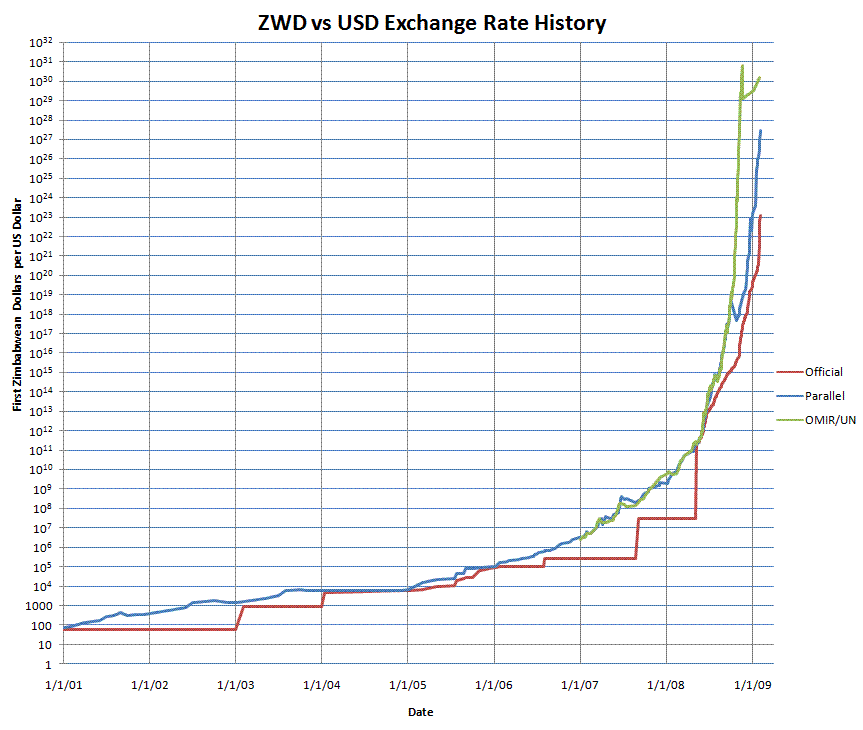
This graph shows the exchange rate between a Zimbabwe dollar (ZWD) and a U.S. dollar (USD).
This graph shows the exchange rate between a Zimbabwe dollar (ZWD) and a U.S. dollar (USD).
Most of this information came from a article that is from around 2007, therefore some of the information here may be incorrect now.
Zimbabwe has suffered from hyperinflation for about five years. In 2006, Zimbabwe had the greatest inflation level in all of Africa. In December 1997, Zimbabwe had an annual inflation rate of twenty percent. In February 2007, Zimbabwe's inflation rate hit 1,594 percent.
Zimbabwe's banking sector is made up of seventeen commercial banks. Three commercial banks, including the largest one, have some degree of state ownership; however the other fourteen are privately owned. Four of the privately owned banks are foreign-owned. A number of the banks have been faced with liquidity crises due to the worsening economy in Zimbabwe. The insurance sector consists of nine life insurance firms, 26 general insurance firms and six re-insurers. All are under the supervision of the Zimbabwe Ministry of Finance, Economic Planning and Development.
Zimbabwe's stock exchange had a market capitalisation of about twenty billion USD at the end of 2006. The stock market offered its highest returns in Africa in 2005 and for most of 2006 despite the deep recession in Zimbabwe. This was driven by local investors hoping to make significant returns on their investments in the midst of hyperinflation.
United States Currency
The United States Currency as everyone knows is the dollar. Here are some things and facts I have found about our currency:
*The US currency is the most used currency in international transactions
*It is a fiat currency (money declared by a government to be the official currency)
-even though it is fiat currency other countries use it as their official currency or their “de facto currency” (not legal tender but used by most of the population)
examples: Lebanon, Zimbabwe, Iraq, Panama, Somalia
*Denominations equal or greater than a dollar are emitted as Federal Reserve Notes
*Denominations less than a dollar are emitted as US Coins
*Made from 75% cotton fiber paper and 25% linen
* Inflation = .74%
*Nicknames:
-buck
-paper
-scrillas
-bones
-dough
-greens
-greenbacks
- (name of person on it)
* $ = two vertical bars with a cloth band in the shape of an “S”
*The US Dollar was created and defined by the Coinage Act of 1792
* Backed by gold
*The dollar is less than a euro
Exchange rate as of 15 min ago: US $1 = € 0.7115
€1 = US $ 1.4055
http://www.dollars2euro.com/ updates it every 15 minutes
* The Bureau of Engraving and Printing is the printer of the money
*The Central Bank is the Federal Reserve Bank-Ben S. Bernanke
* The Mint is the United State Mint (where the money is made)
*During fiscal year 2007, the Bureau of Engraving and Printing (BEP) produced approximately 38 million notes a day with a face value of approximately $750 million.
*95% of the notes printed each year are used to replace notes already in, or taken out of circulation.
*The first paper currency issued by the U.S. Department of the Treasury were Demand Notes Series 1861.
*You could get a $5,000 fine or 15 years in prison if you are found counterfeiting currency.
*The U.S. technically makes money when it prints more because of seigniorage. This means that it takes a few cents to make a quarter but in circulation it is 25 cents. This puts extra funds in the Treasury and goes towards education, health care, and defense.
*The life expectancy of a circulating coin is 30 years, while paper money usually only lasts for 18 months.
Works Cited: www.federalreserve.gov and www.moneyfactory.gov and www.usmint.gov
*The US currency is the most used currency in international transactions
*It is a fiat currency (money declared by a government to be the official currency)
-even though it is fiat currency other countries use it as their official currency or their “de facto currency” (not legal tender but used by most of the population)
examples: Lebanon, Zimbabwe, Iraq, Panama, Somalia
*Denominations equal or greater than a dollar are emitted as Federal Reserve Notes
*Denominations less than a dollar are emitted as US Coins
*Made from 75% cotton fiber paper and 25% linen
* Inflation = .74%
*Nicknames:
-buck
-paper
-scrillas
-bones
-dough
-greens
-greenbacks
- (name of person on it)
* $ = two vertical bars with a cloth band in the shape of an “S”
*The US Dollar was created and defined by the Coinage Act of 1792
* Backed by gold
*The dollar is less than a euro
Exchange rate as of 15 min ago: US $1 = € 0.7115
€1 = US $ 1.4055
http://www.dollars2euro.com/ updates it every 15 minutes
* The Bureau of Engraving and Printing is the printer of the money
*The Central Bank is the Federal Reserve Bank-Ben S. Bernanke
* The Mint is the United State Mint (where the money is made)
*During fiscal year 2007, the Bureau of Engraving and Printing (BEP) produced approximately 38 million notes a day with a face value of approximately $750 million.
*95% of the notes printed each year are used to replace notes already in, or taken out of circulation.
*The first paper currency issued by the U.S. Department of the Treasury were Demand Notes Series 1861.
*You could get a $5,000 fine or 15 years in prison if you are found counterfeiting currency.
*The U.S. technically makes money when it prints more because of seigniorage. This means that it takes a few cents to make a quarter but in circulation it is 25 cents. This puts extra funds in the Treasury and goes towards education, health care, and defense.
*The life expectancy of a circulating coin is 30 years, while paper money usually only lasts for 18 months.
Works Cited: www.federalreserve.gov and www.moneyfactory.gov and www.usmint.gov
argentina currency

since the "dirty war" in the 1970's, the economy and currency value in argentina have fluctuated greatly. the goal for the argentine government was to keep the argentine peso at 1 to 1 with the us dollar to promote economic stability.
in 1999, due to the recession, the IMF gave argentina a $40 billion aid package. even with this, the economy continued to fail. and in 2002, the governments goal of keeping the peso at a 1 to 1 with the us dollar was abandoned. after this in 2002, the argentine peso became a free floating currency and lost 60% of its value.
but do to major reforms in the argentine economy, the peso has seen a steady recovery. as an additional effort to increase the strength of the peso, the government has been buying on average $20 million usd per day.
on the graph, it measures the CPI, which shows the inflation at the current time.
http://en.wikipedia.org/wiki/Argentine_economic_crisis_(1999%E2%80%932002)
Friday, June 26, 2009
Romania Industry and Working
Industry
Romania has rich and fertile land which has abundant mineral deposits. However, since the 1960's industry has gradually passed agriculture as the country's main source of income as well as its primary employer. Romania does not specialize in just one or two products. Romania makes a variety of different things. Their main industries are iron, steel, nonferrous metals, chemicals, food processing, machinery and transportation equipment, textiles and clothing, electronics, construction, furniture and other wood products, shipbuilding and refurbishment, windmills, pharmaceuticals, medical equipment, textiles and footwear, light machinery and auto assembly, mining, timber, construction materials, metallurgy, petroleum refining, and computers.


Working
The unemployment rate is about 6% and 25% of the population live below the poverty line.
-a person can legally work at the age of 16
-may work at 15 with parents permission
-cannot work if under 15
-full time consists of 8 hours a day and 4o hours a week
-full time employees cannot go over 48 hours in one week, including overtime
-for every 5 days of 8 hour work, there must be two days off
-people under 8 can only work up to 6 hours a day and 3o hours a week
-if shifts are 12 hours, it must be followed by 24 hours of rest
-minimum wage is 600 new lei which is $198.89 US per month
Romania has rich and fertile land which has abundant mineral deposits. However, since the 1960's industry has gradually passed agriculture as the country's main source of income as well as its primary employer. Romania does not specialize in just one or two products. Romania makes a variety of different things. Their main industries are iron, steel, nonferrous metals, chemicals, food processing, machinery and transportation equipment, textiles and clothing, electronics, construction, furniture and other wood products, shipbuilding and refurbishment, windmills, pharmaceuticals, medical equipment, textiles and footwear, light machinery and auto assembly, mining, timber, construction materials, metallurgy, petroleum refining, and computers.


Working
The unemployment rate is about 6% and 25% of the population live below the poverty line.
-a person can legally work at the age of 16
-may work at 15 with parents permission
-cannot work if under 15
-full time consists of 8 hours a day and 4o hours a week
-full time employees cannot go over 48 hours in one week, including overtime
-for every 5 days of 8 hour work, there must be two days off
-people under 8 can only work up to 6 hours a day and 3o hours a week
-if shifts are 12 hours, it must be followed by 24 hours of rest
-minimum wage is 600 new lei which is $198.89 US per month
Works Cited
Subscribe to:
Posts (Atom)